
The Reputation Economy of Agentic Commerce: Why Experience Beats Price

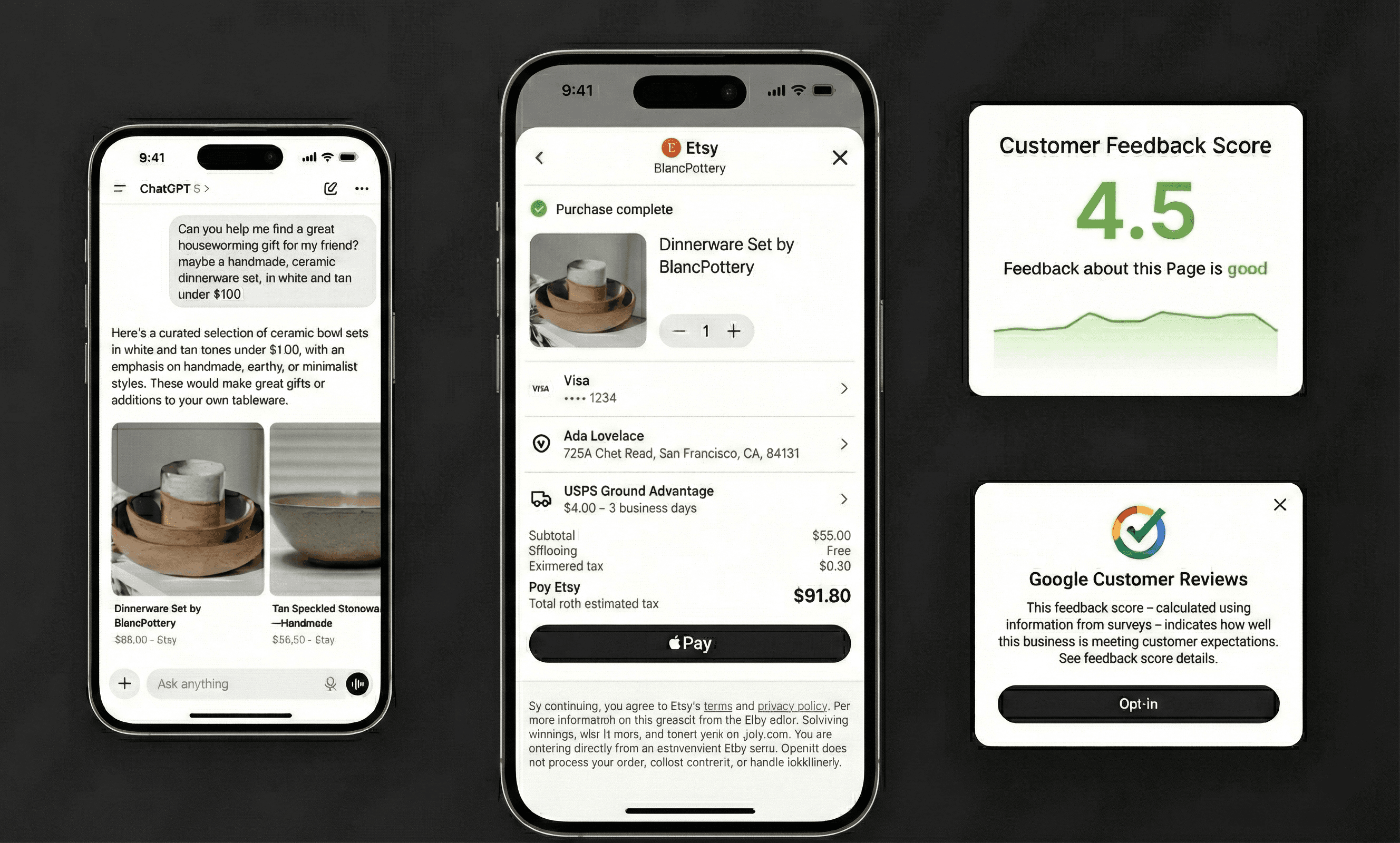
KEY TAKEAWAYS
- Agentic commerce is projected to generate up to $1 trillion in U.S. B2C retail revenue by 2030, with global projections reaching $3 trillion to $5 trillion (McKinsey, October 2025). Morgan Stanley estimates agentic shoppers could capture 10% to 20% of U.S. e-commerce market share by the end of the decade
- Price will not be the primary ranking signal—agentic platforms will weight operational performance as heavily or more heavily than price competitiveness. The precedent is already established across Google Merchant Center, Amazon Buy Box, and every major transaction platform
- Reputation will be cross-categorical—a merchant's performance on commodity, AI-purchased items will directly influence whether agentic platforms recommend that merchant for higher-consideration products across all channels
- Early movers will compound a structural advantage—reputation systems reward consistency over time and resist rapid displacement, identical to domain authority in search
- The strategic window is open now, before any major platform has deployed a formal merchant reputation system
The Experience That Changes Everything
Imagine you ask your AI assistant to reorder running shoes. Same brand, same model you bought six months ago. The agent identifies three authorized retailers. One offers the lowest price but with unclear shipping times. Another offers a mid-range price with standard three-day shipping. The third charges slightly more, but offers next-day delivery and has the lowest complaint rate across its last ten thousand transactions.
The agent doesn't ask which store you prefer. It weighs the variables against your history: you value fast delivery, you've shown no strong price sensitivity on athletic purchases. It completes the transaction with the third retailer. You receive a confirmation. The shoes arrive the next morning.
Now consider the inverse. The agent selects the lowest-price retailer. The shoes arrive six days late. The sizing runs small. The return process requires three emails and a fourteen-day wait for refund processing. You don't blame the retailer. You may not even remember which retailer the agent chose. You blame the AI. You lose confidence in its judgment. You start second-guessing its recommendations. Perhaps you stop using it for purchases entirely.
This asymmetry, where the platform bears the reputational cost of merchant failure, is the force that will reshape how agentic commerce operates. It has already reshaped every transaction platform before it. And its implications run deeper than most operators expect: a merchant's performance on routine, low-margin orders will shape whether AI agents recommend that merchant for entirely different product categories.
1. What Is Agentic Commerce?
Agentic commerce describes a purchasing model in which an AI agent acts as an autonomous intermediary between consumer intent and merchant fulfillment. Rather than browsing product pages, comparing options, and completing checkout manually, the consumer delegates the full transaction lifecycle to a software agent that operates on learned preferences, explicit instructions, and contextual data.
The model spans a spectrum of autonomy. At one end, agents function as intelligent assistants, surfacing recommendations that require human approval. ChatGPT Instant Checkout, Perplexity's Buy with Pro, and Google's AI Mode all follow this pattern today: the agent curates, the human confirms. At the other end, agents operate with delegated authority. The consumer sets rules ("buy if under $80 from a trusted merchant") and the agent executes autonomously, escalating only when something falls outside those boundaries. Amazon's "Buy for Me" feature and Google's agentic checkout already represent this second model entering production.
The scale is no longer speculative. OpenAI launched native checkout in ChatGPT in September 2025, expanding to over one million Shopify merchants. ChatGPT surpasses 700 million weekly active users and processes an estimated 50 million shopping-related queries daily. Adobe Analytics data shows generative AI traffic to U.S. retail sites surged 4,700% year-over-year by July 2025, and during the holiday season, that traffic converted at rates 31% higher than non-AI sources. McKinsey projects agentic commerce could generate up to $1 trillion in U.S. B2C retail revenue by 2030, with global projections reaching $3 trillion to $5 trillion.
The common assumption among e-commerce operators is that agentic commerce will function primarily as automated price comparison. This reflects a fundamental misunderstanding of how these platforms will generate and retain user trust. Price comparison is a feature. Trust maintenance is the business model.
The merchants who treat agentic commerce as a price war are making the same mistake merchants made with marketplace algorithms fifteen years ago. The algorithm doesn't optimize for the merchant's margin. It optimizes for the platform's retention. And retention is a function of experience, not price.
2. What Enables It? The Infrastructure of Merchant Reputation
The Ad Platform Precedent
The reputation mechanics that will govern agentic commerce are not theoretical. They are already operational at scale across every major advertising and transaction platform.
Google Merchant Center maintains a merchant quality score derived from return rates, shipping time accuracy, customer review sentiment, and dispute frequency. Merchants below threshold face reduced visibility or account suspension. Meta operates an analogous system across its commerce surfaces. Amazon's Buy Box algorithm, which determines which seller wins the default purchase position on any product, weights fulfillment reliability, customer service metrics, and account health as heavily as price competitiveness. Uber's driver rating system demonstrates the same principle in services: the platform intermediates the transaction, stakes its brand on the outcome, and therefore must score the supply side to protect user trust.
The pattern is universal. Whenever a platform intermediates a transaction and attaches its reputation to the outcome, it builds a scoring system to manage supply-side quality. The only variable is timing.
Why Agentic Platforms Will Follow the Same Path
Agentic commerce platforms face an even stronger version of this incentive, for a critical reason: the AI agent is the interface. When a consumer shops on Amazon, a poor merchant experience is associated with both Amazon and the specific seller. The consumer can see the seller's name, read its reviews, make an informed judgment. In agentic commerce, that separation collapses. The platform selects the merchant, mediates the transaction, and attaches its brand to the outcome. The consumer's experience of the merchant is their experience of the platform.
This creates an asymmetric liability structure. The platform absorbs the full reputational cost of every merchant failure but captures only a fraction of the benefit from merchant success, since success is the expected baseline. Under these conditions, aggressive quality filtering is not merely advisable. It is existential.
OpenAI, Perplexity, Google, and every other entrant building agentic commerce infrastructure will arrive at the same conclusion: the only way to protect user trust at scale is to track, score, and filter merchants based on post-transaction performance data. The resulting reputation systems will function as gatekeepers, determining not merely how prominently a merchant appears in agent recommendations, but whether the merchant appears at all.
This liability structure operates across the entire automation curve, and it intensifies at every level.
At assisted levels, the AI functions as a curator. The user sees which merchant the agent selected, but the agent chose which merchants to surface. When ChatGPT presents three retailers and the user's chosen option delivers late or makes returns difficult, the failure is attributed to ChatGPT's judgment. The user begins verifying independently. The platform's core value proposition erodes. This is precisely why OpenAI already ranks product results using signals that include availability, price, quality, and primary seller status. These are the early inputs of a reputation system, even if not yet formalized as a score.
At supervised execution levels, the liability sharpens. When users set rules and the agent acts within guardrails, the user is less likely to evaluate or remember which specific merchant was selected. Attention shifts from merchant identity to outcome quality. A pattern of poor outcomes at this level doesn't just reduce trust in individual recommendations. It undermines the user's willingness to delegate at all.
At fully autonomous levels, the exposure becomes existential. When agents manage ongoing goals or negotiate directly with merchant systems, the consumer may never evaluate individual transactions. A platform that consistently routes autonomous transactions to underperforming merchants will lose user trust faster than any traditional marketplace, because the user granted broad discretionary authority and the agent failed to exercise it competently. At this level, reputation scoring is not a feature. It is the minimum infrastructure required for the platform to function.
Platforms will build reputation systems early, while most transactions are still assisted, and make those systems progressively more aggressive as autonomy scales. The scoring infrastructure will be in place before full autonomy arrives. The merchants building track records now will carry those records into the autonomous era. The merchants who wait will face a cold start against established performance data.
Three Models of Reputation Integration
Based on the trajectory of existing platform scoring systems, merchant reputation in agentic commerce is likely to manifest through three distinct models:
- Threshold gating. Merchants must meet minimum performance benchmarks to remain eligible for agent-mediated transactions. Stores falling below thresholds on fulfillment accuracy, return rate, or dispute frequency are excluded entirely. This mirrors Google Merchant Center's suspension mechanics.
- Weighted ranking. Merchants meeting baseline thresholds are ranked by a composite score incorporating price competitiveness, fulfillment performance, customer satisfaction, and category-specific quality indicators. This mirrors Amazon's Buy Box algorithm.
- Dynamic trust allocation. The agent adjusts its confidence in a merchant based on real-time performance trends, routing more volume to merchants on upward trajectories and reducing allocation to those showing deteriorating metrics. This mirrors Uber's dynamic driver-dispatch weighting.
Most mature agentic platforms will likely operate all three simultaneously: threshold gating as the entry requirement, weighted ranking as the standard allocation mechanism, and dynamic trust allocation as the real-time optimization layer.
3. What Does It Mean for Business? The Full Value Equation
Price Is a Variable. Experience Is the Multiplier.
The assumption that agentic commerce will be dominated by price competition projects human browsing behavior onto an entirely different decision architecture. Human shoppers over-index on price because comparison is cognitively expensive; price is the most easily comparable attribute, so it receives disproportionate weight under time pressure. AI agents face no such constraint. An agent can evaluate fulfillment speed, return policy terms, customer satisfaction scores, product accuracy ratings, and support responsiveness across dozens of merchants in milliseconds. Price becomes one input among many, weighted according to the individual user's revealed preferences.
Existing platforms already confirm this. On Amazon, over 80% of purchases flow through the Buy Box, yet the lowest-priced offer does not automatically win. Amazon's algorithm weighs fulfillment method, seller performance metrics, shipping speed, and account health alongside price. Sellers using Fulfillment by Amazon receive significant algorithmic preference over merchant-fulfilled offers regardless of price differential. On Google Shopping, merchants with strong quality scores receive preferential placement even at higher price points. This pattern will intensify as AI agents gain access to richer post-transaction data.
For merchants, this reframes the competitive landscape. The winning position is not lowest cost. It is the optimal combination of fair pricing and operational excellence across four dimensions:
- Fulfillment reliability. Orders arrive within the promised window, with accurate tracking and proactive communication on exceptions.
- Product-promise alignment. The received product matches what was represented in the listing, in specifications, quality, and condition.
- Resolution velocity. When failures occur (and they will), the merchant resolves them quickly, generously, and with minimal customer effort.
- Friction minimization. Returns, exchanges, and support interactions require the fewest possible steps and the shortest possible time to resolution.
Price competitiveness remains necessary. A merchant charging a 40% premium for an identical commodity product will not overcome the differential through experience alone. But among merchants operating within a reasonable price band, experience quality will be the decisive differentiator. A fast and generous resolution to a shipping failure may generate a stronger positive signal than a routine successful transaction, because it demonstrates reliability under stress. That is precisely the attribute an agentic platform most needs to trust.
When every transaction outcome is a data point feeding an algorithm that determines your visibility, customer service stops being a cost center. It becomes the highest-ROI investment in your business.
The Cross-Reputation Effect
This is the dimension of agentic commerce that most operators have not yet considered, and it carries the most significant strategic implications.
Not all products in a merchant's catalog will be purchased through agentic channels. High-consideration, emotionally significant, or aesthetically driven purchases will remain human-directed for years. But a meaningful subset, commodity items, consumable replenishments, routine re-purchases, and low-consideration accessories, will migrate naturally to agent-directed purchasing. These are the transactions where consumers derive the least satisfaction from personal involvement.
This subset will generate the merchant's reputation score within agentic platforms. And that score will not remain confined to the categories that generated it.
When a consumer later asks their AI agent to recommend a piece of furniture, an electronic device, or a gift, the agent will reference the merchant's aggregate reputation, including performance data from entirely unrelated commodity transactions. The merchant's fulfillment accuracy on paper towel subscriptions will influence whether the agent recommends that merchant's premium product lines.
The analogy is to credit scoring. A consumer's payment history on a car loan affects their mortgage eligibility, not because automobile lending and home lending are the same activity, but because both indicate the same underlying variable: reliability. A merchant's performance on low-margin commodity orders signals the same variable that matters for all transactions: operational trustworthiness.
This dynamic creates a strategic imperative that many merchants will recognize too late. The temptation will be to treat agentic commodity orders as low-priority, to allocate minimal operational attention to low-margin, automated transactions. This is precisely the wrong response. Every agentic transaction is a reputation-building event. Every fulfillment failure on a commodity order erodes the merchant's standing for high-margin recommendations. The stakes on a $12 subscription refill are not the $12. They are the merchant's aggregate visibility across the platform's entire recommendation surface.
Reputation Compounds. Late Entry Penalizes.
Reputation systems share a structural characteristic with search engine authority: they reward sustained consistency over time and resist rapid displacement. A merchant that builds a strong track record across thousands of agentic transactions holds a position that a new entrant, regardless of operational capability, cannot replicate quickly. The incumbent has data depth. The new entrant has a cold start.
The strategic window for building agentic reputation is now, during the infrastructure build-out phase, when transaction volumes are manageable and performance standards have not yet been formally codified. Merchants who establish baseline performance data during this period will enter the scoring era with a head start that compounds with every subsequent transaction.
The cost of delay is not linear. It is exponential.
4. What Should You Do? Strategic Questions for E-Commerce Leadership
Rather than a predetermined playbook, the right response is a rigorous assessment of organizational readiness. These questions are designed to guide that process.
Operational baseline
- What is your current fulfillment accuracy rate, and how does it compare to the top quartile in your category?
- What is your average resolution time for customer complaints, and what percentage are resolved in one interaction?
- Do you have real-time visibility into post-purchase customer satisfaction, or do you rely on lagging indicators like return rates and review scores?
Agentic readiness
- Which products in your catalog are most likely to migrate to agent-directed purchasing first, and are those products receiving best-in-class operational attention?
- Are your product data feeds structured for machine readability, not just search engine indexing, but the richer attribute sets that AI agents will require?
- Do your fulfillment and support systems generate the structured data that reputation scoring algorithms will need to evaluate your performance?
Strategic positioning
- If agentic commerce reputation scores were published tomorrow, where would your store rank relative to your three closest competitors?
- Are you investing in customer experience improvements that compound in value as reputation systems mature, or optimizing for short-term metrics that may not align with platform scoring criteria?
- Do you have a cross-functional team spanning operations, technology, and customer experience that owns your agentic commerce readiness, or is this treated as a marketing initiative?
Innovate or renovate
- Which existing systems (order management, customer support, returns processing, product data management) need incremental improvement to meet agentic commerce standards?
- Which capabilities are fundamentally absent: real-time performance monitoring, structured transaction outcome data, AI-optimized product feeds?
The right answers depend on category dynamics, competitive positioning, and operational maturity. What is universal is the cost of not asking.
The Path Forward
Every platform that has intermediated transactions at scale has built merchant scoring systems to protect user trust. Agentic commerce platforms, where the AI absorbs the full reputational cost of merchant failure, face even stronger incentives to do the same. The merchants who recognize this early and treat every transaction as a reputation-building event will hold compounding advantages that late entrants cannot easily overcome.
The scoring has not started yet. That is not a reason for comfort. It is the reason to begin.
We build custom commerce solutions that help merchants thrive in the reputation economy. If the questions in this article resonated, we'd love to hear what you're working on.
Frequently asked questions
Agentic commerce is a purchasing model in which an AI agent acts as an autonomous intermediary between consumer intent and merchant fulfillment. Rather than browsing and checking out manually, the consumer delegates these tasks to a software agent that executes the full transaction lifecycle based on learned preferences, explicit instructions, and contextual data. Major platforms including OpenAI (ChatGPT), Perplexity, Google, and Microsoft are already building agentic commerce infrastructure.
No. AI agents face none of the cognitive constraints that lead human shoppers to over-weight price. An agent can evaluate fulfillment speed, return policy terms, customer satisfaction scores, and support responsiveness across dozens of merchants in milliseconds. Price becomes one input among many. The empirical evidence from existing platforms like Amazon's Buy Box confirms this: the lowest-priced offer does not automatically win when operational performance metrics are factored in.
The cross-reputation effect means that a merchant's performance on commodity, agent-purchased items (like routine replenishments) will directly influence whether agentic platforms recommend that merchant for higher-consideration products. Your fulfillment accuracy on low-margin subscription orders affects your visibility for premium product recommendations. Every agentic transaction is a reputation-building event, regardless of order value.
Now. No major agentic platform has deployed a formal merchant reputation system yet, but the period between platform launch and scoring implementation is the highest-leverage moment to establish baseline performance data. Reputation systems reward sustained consistency over time, so merchants who build strong track records before formal scoring launches will hold positions that late entrants cannot easily displace.
Let's buildyour reputation.
AI agents will score merchants on fulfillment, returns, and satisfaction—not just price. We help brands build the operational infrastructure that earns trust from agentic platforms before the scoring starts.